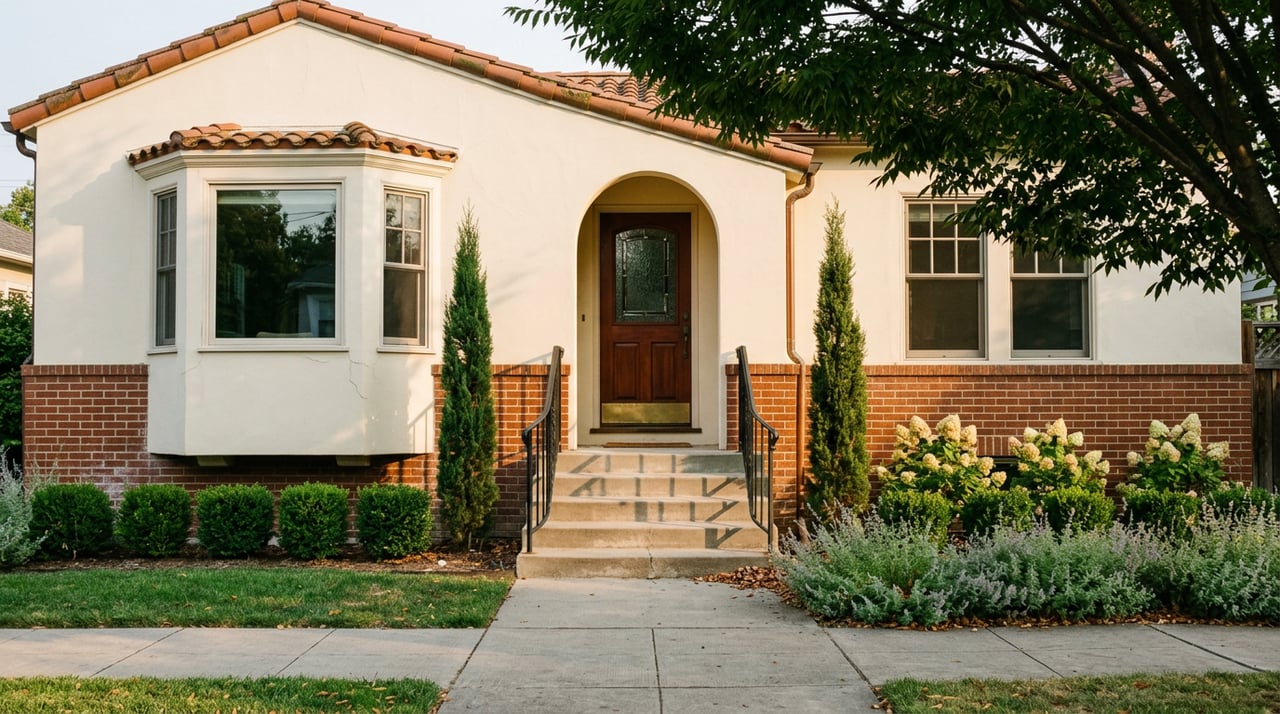
Why Comps From Ten Blocks Away Don't Work in Gravesend
August 13, 2026
August 13, 2026
In July 2026, a twelve-unit condo building at 346 Avenue U closed its priciest unit for $7.5 million. The building is called Opal Residences, developed by Redhoek+Partners, and the sale set a new price-per-square-foot record for condo product in Gravesend, a neighborhood where the median home price stood at $649,999 as of August 2025.
That gap is not a typo and it is not a bubble. It is the whole story of how real estate actually prices in this corner of Brooklyn, and understanding it matters if you are trying to make sense of what a Gravesend address will actually cost you.
As of August 2025, the median home price in Gravesend stood at $649,999, with the 12-month median closer to $560,000 and homes averaging 72 days on market, according to market tracking published at the time. That put Gravesend well below the borough-wide median, which Corcoran's Q2 2025 report placed at $810,000, and below the $998,000 figure Brooklyn closed out 2025 at overall.
On paper, that reads as a straightforward story: Gravesend is one of Brooklyn's more affordable pockets, a place where first-time buyers and families can find single-family homes and two-family houses without competing at brownstone-belt prices. That story is true for most of the neighborhood. It is also incomplete, because the median is doing something medians are bad at admitting: blending two markets that do not talk to each other.
Inside Gravesend sits a small, dense pocket where none of the numbers above apply. Reporting from The Real Deal places most of this activity in a square bounded by McDonald Avenue to the west, Ocean Parkway to the east, Avenue R to the north, and Avenue U to the south. Brooklyn Eagle's coverage of the neighborhood's record sale describes the same pocket as centered between Avenues S and U.
Recent sales inside that square tell you what "median" cannot:
None of those figures show up as an anomaly in the median because several of them, including the $32 million sale, closed off-market. They never spent a day counted in anyone's "days on market" average. They simply happened, deed recorded, comps unaffected for everyone else nearby who still prices against the visible market.
What makes these blocks different is not lot size or finishes. It is walking distance. Gravesend has been home to a large Sephardic Jewish community, largely Syrian in origin, since the 1940s, with several major synagogues concentrated along Ocean Parkway, including Congregation Share Zion. For households that observe the Sabbath by not driving, a home's distance from those synagogues functions the way a subway stop or a top-rated school zone functions elsewhere in the city: it is priced directly into the property, sometimes more heavily than square footage or renovation quality.
That single variable, walkability to a specific corridor, is why homes on some blocks command seven and eight figures while homes a short drive away sell in the high five figures to low seven figures. It is a real estate mechanism like any other. It just happens to operate at a scale of a few blocks rather than a few miles, which is exactly what breaks the comp tools most buyers and even some lenders rely on.
Cohen, the Opal Residences developer, described the practical consequence of this in blunt terms. Convincing lenders unfamiliar with the neighborhood that a Gravesend condo could reasonably sell above $2,000 per square foot, for a product type the area had never really tested, was not an easy conversation.
"You can't pull comps from 10 blocks away, because 10 blocks away may be outside of that circle of the micro [neighborhood]."
That line is the whole thesis. An appraiser working from a standard radius search, or a lender running an automated valuation model, will happily pull comps from Stillwell Avenue or Kings Highway and land on a number that has nothing to do with a property three blocks from Ocean Parkway. The reverse is just as true: a buyer comparing a house near Avenue U to the $32 million record sale down the block is comparing two different asset classes that happen to share a zip code.
| Rest of Gravesend | The Ocean Parkway Enclave | |
|---|---|---|
| Typical product | Single-family homes, two-family houses, co-ops and condos | New construction and rebuilt single-family homes, boutique condo product |
| Reported median (Aug 2025) | $649,999, 12-month median $560,000 | Not captured by standard median; recent trades $7M–$32M |
| How deals happen | Listed, marketed, tracked through standard days-on-market data | Frequently off-market, transacted between known buyers |
| What drives price | Bedroom count, lot size, condition, transit access | Distance on foot from Ocean Parkway synagogues |
Does this mean most of Gravesend is out of reach for a typical buyer? No. The enclave described here is a small geographic pocket, not the whole neighborhood. Most of Gravesend, including areas served by two-family houses being converted back to single-family use and a mix of co-ops and condos, still prices well below Brooklyn's borough-wide median as of the most recent reporting available.
How do I know if a specific address falls inside the high-demand pocket? The rough boundary reported is McDonald Avenue to the west, Ocean Parkway to the east, Avenue R to the north, and Avenue U to the south, with the heaviest activity between Avenues S and U. Distance to Ocean Parkway is the variable that matters most, block by block.
If I'm selling near that boundary, what should I ask my agent to do differently? Ask for a comp set built from the specific blocks, not a standard radius search, and ask whether recent off-market activity in the immediate area should factor into your pricing strategy before you list.
Gravesend rewards buyers and sellers who understand that a single median number is standing in for two very different markets. If you're trying to figure out which side of that line your address falls on, or what it means for how you should price or finance a purchase here, Olga Moldavsky can walk you through the comps that actually apply to your block. Let's Connect.
Stay up to date on the latest real estate trends.
Navigating the unique pockets of Brooklyn requires an agent who truly knows the heartbeat of the borough. I bring years of neighborhood insight and data-driven strategy to the table to help you reach your goals. Connect with me today and let's turn your Brooklyn real estate dreams into reality.
OLGA MOLDAVSKY
ADDRESS
1812 Bath Ave
Brooklyn, NY 11214